Most Recent Common Ancestor
Completion requirements
View
The most recent common ancestor is the furthest internal node that connects two or more tips/groups. You’ll often see Most Recent Common Ancestor abbreviated as MRCA.
Lets take a very simple example using a phylogeny of the Vipers.
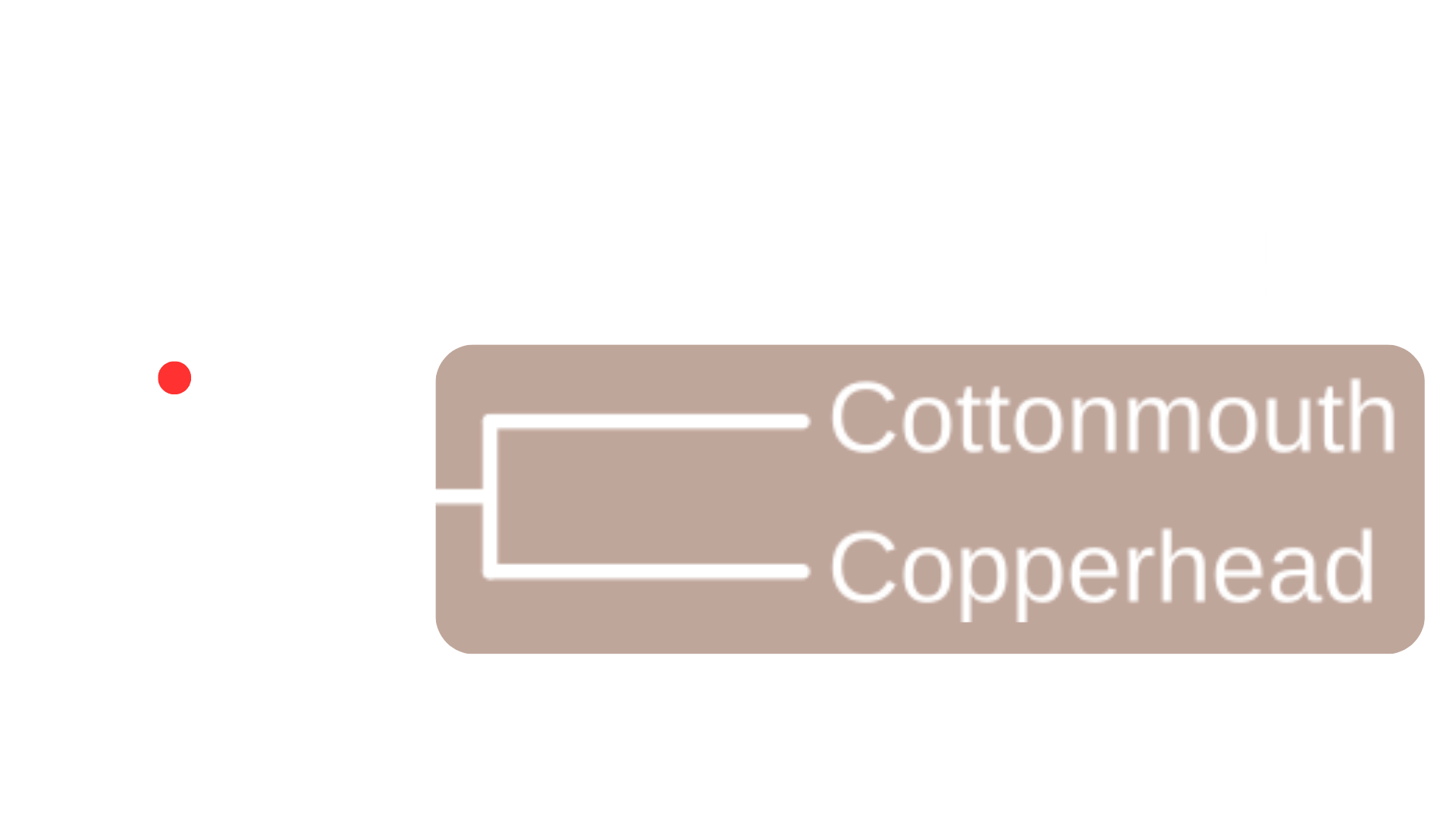
If we zoom in on Copperheads (Agkistrodon contortix) and Cottonmouths (Agkistrodon piscivorous), we find their most recent common ancestor is at the node highlighted here in Red.
But know that it doesn’t have to be just the tips of a phylogeny! We can also do entire groups of organisms. For example, the figure below shows the MRCA highlighted in red for all rattlesnakes and the group containing Copperheads and Cottonmouths (otherwise known as the “Agkistrodon genus”).
Last modified: Thursday, 27 November 2025, 8:18 AM